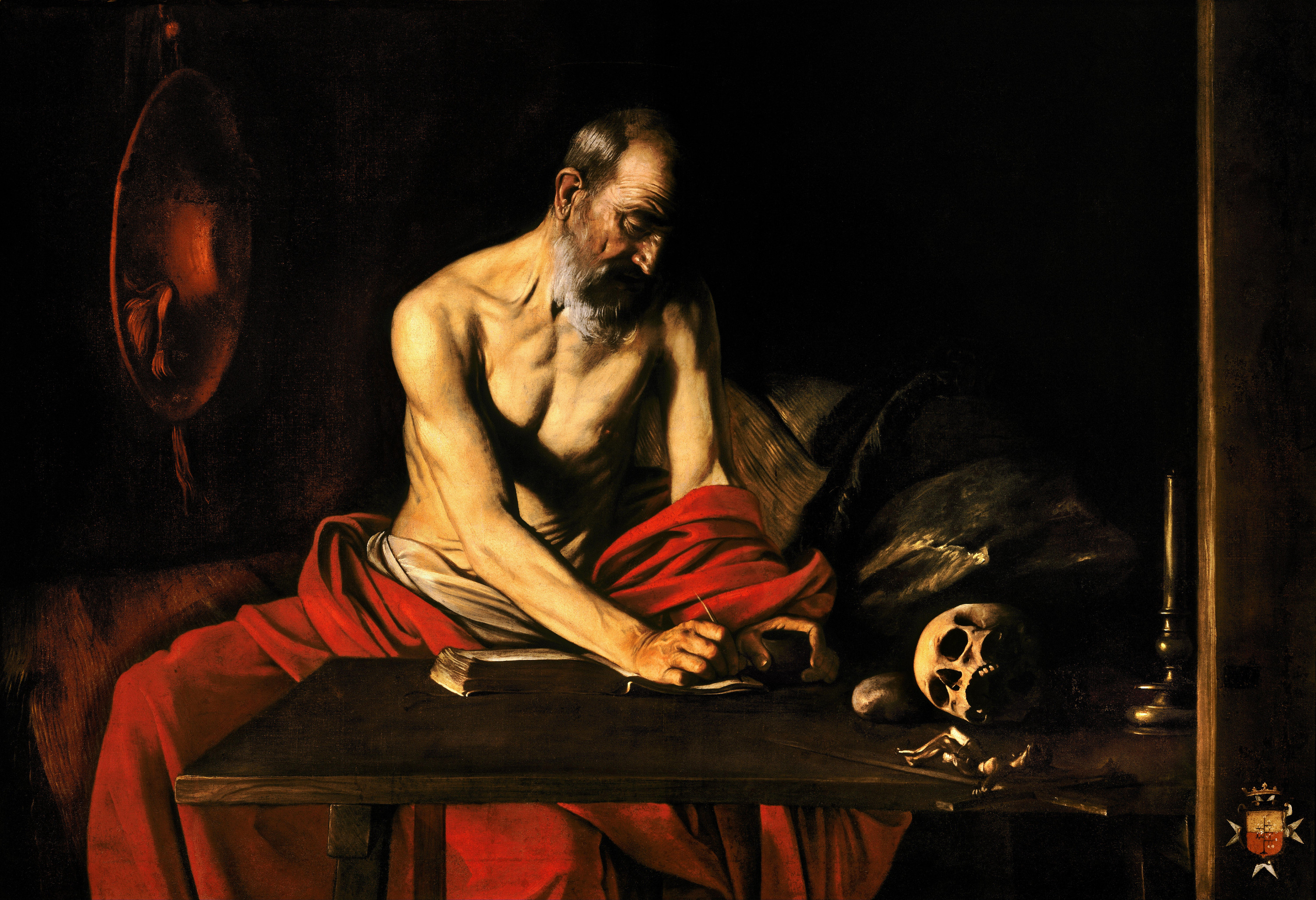
 Saint Jerome Writing, Caravaggio ~ Valletta, Malta
On the Translation of the Final Clause of the Our Father
French Catholics have decided to change their translation of the Our Father. This change, and its subsequent vote of confidence from Pope Francis, have filled the news cycle in the last day or so. The critical debate centers around the final clause:
| Year | French | English |
|---|---|---|
| 1966 | ne nous soumets pas à la tentation | submit us not to temptation |
| 2017 | ne nous laisse pas entrer en tentation | let us not enter into temptation |
Before we can evaluate any proposed change to the French translation, we need to begin by understanding the larger translation problems in this particular verse. Matthew 6:13, from which the liturgical text of the Our Father is drawn, indeed has a number of issues.
The Doxology
The first question we must address is the actual contents of the verse. Those familiar with the King James Version are used to hearing Matthew 6:13 read in this form:
And lead us not into temptation, but deliver us from evil: For thine is the kingdom, and the power, and the glory, for ever. Amen.
In the previous century, Tyndale had likewise translated the verse as:
And leade vs not into teptacion: but delyver vs fro evell. For thyne is ye kyngedome and ye power and ye glorye for ever. Amen.
However, Wycliffe had translated the verse thusly:
and lede vs not in to temptacioun, but delyuere vs fro yuel. Amen.
Wycliffe’s omission of the doxology was not unintentional. Nor was it an error. Indeed, the doxology was itself a textual feature of the Byzantine manuscript tradition. Scholars now agree that it was not original to the text. For this reason, most modern translations - following Wycliffe - omit the doxology or relegate it to a footnote.
The doxology first appeared in Greek in the Didache, though not directly following the Our Father. It does not appear in the quotations of the verse in Origen, Tertullian or St. Cyprian - a testament to the early Alexandrian manuscript tradition. The first record of the addition to the text appears to be St. John Chrysostom’s Homily 19 on St. Matthew. Today, the consensus of scholars is that the doxology had been inserted by an eager scribe to conform the Matthean text to the Byzantine liturgical tradition.
However, in the West the doxology was practically unknown. Jerome’s Vulgate never included the doxology. Likewise, until after Vatican II, the doxology was excluded from the Latin liturgical texts. Today it is commonly included in English Catholic masses (an oddity given its absolute foreignness to the Latin liturgical tradition, but likely a nod to Anglican usage).
The Evil One?
A second important translation issue arises from an ambiguity in Greek. If we omit the doxology, the final three words before “Amen” are: ἀπὸ τοῦ πονηροῦ. The difficulty is that this can be translated in two different ways. The most common translation in English is that of Wycliffe and his successors: “from evil.” However, this particular construction in Greek (literally: “from the evil”) can also be translated as “from the evil one”, referring of course to Satan, depending on whether you take τοῦ πονηροῦ to be masculine or neuter.
This later translation option has become an incredibly popular one. It is the chosen translation in the ISV, NET, ASV, ERV, NLT and others. This translation choice also has some precedent in Pseudo-Clement (Clementine Homilies, Homily XIX, Chapter II). Further, some have argued that the change to “evil” arose as a byproduct of the translation into Latin. The argument goes that since Latin lacks a definite article (“sed libera nos a malo”), it created a tendency to reduce “the evil one” to “evil.”
Let’s take each of these claims in turn.
First, Latin can happily receive the same reading without the definite article. In fact, we can simply prove this with a reference to the Nova Vulgata (1979), which renders the text “sed libera nos a Malo”; using the capital letter to clearly establish “the evil one” as the preferred translation. Simply put, where Greek always uses the definite article in this construction, Latin never uses it. But both readings are equally possible in both languages.
Second, while it is true that Pseudo-Clement takes “the evil one” reading, St. Cyril of Alexandria does not. In Sermon 67 on Luke, St. Cyril says this:
And there is a certain close connection in the clauses: for plainly it follows from men not being led into temptation, that they are also delivered from evil; or perchance, were any one to say, that the not being led into it is the same as the being delivered from it, he would not err from the truth.
In the Greek, Cyril uses the neuter pronoun. Thus, the translator correctly renders “delivered from it” rather than “delivered from him.” Since the antecedent of this pronoun is τοῦ πονηροῦ, this forms an early, native language interpretation of the passage as “evil” rather than “the evil one.” Thus, it is reasonable to conclude that the ambiguity does in fact exist in the original text and that either translation is reasonable.
Temptation or Trial?
Nevertheless, modern scholars tend to prefer “the evil one” for another reason. This reasoning has to do with the ambiguity of πειρασμὸν, which can mean either temptation or trial. In the latter case, the verse is actually setting up a Hebrew legal construct. We see this construct as early as Job 1:6 where Satan is understood to be as a sort of prosecuting attorney (“the accuser”). If we apply this reasoning to the verse in question, the meaning becomes apparent with this loose paraphrase:
Forgive us our debts as we forgive those indebted to us; and do not hand us over to be prosecuted in a court trial, but deliver us from the prosecuting attorney.
In this rendering, the verse in question bears a close relationship to the preceding verse. First, the prayer appeals to the Father’s justice: I have been merciful, so be merciful to me. Then in the subsequent verse the precise nature of the desired mercy is revealed: don’t send me to debtors court where the evil one will try to have me convicted.
The biggest problem with this reading is simply that it disappears by the fourth century, even among native Greek speakers. So, when trying to decide on a translation methodology for this verse, the purpose of the translation will have to be considered carefully. An academic translation for the purpose of education or study may choose to render one version or another (or both!). In contrast, a liturgical translation should keep continuity with previous translations as one of its highest goals to avoid a disruption of piety. Similarly, a liturgical translation should intend to render, as closely as possible, the grammar of the underlying text; this avoids interpretive bias and makes liturgical texts a fertile ground for theological reflection.
The Imperative of Permission?
Perhaps most directly related to the question of the new translation is the question of how to interpret the verb εἰσενέγκῃς, which means to carry or to lead. The verb is uncontroversially in the imperative mood, which indicates a relation of will from the speaker to the hearer. However, the question remains: which kind of imperative is it?
The most common imperative, by far, is the imperative of command or prohibition.1 For example, in Matthew 8:9, the centurion uses the command imperative to explain how one in authority can issue commands that must be obeyed. A prohibition imperative is simply inverse of a command imperative: where a command imperative identifies that a person must do a thing, a prohibition imperative indicates that a person must not do a thing. Think: “Thou shalt not kill.” “Lead us not…” is, clearly, neither a command or prohibition imperative. Indeed, this is precluded by the beginning of the prayer itself: “Thy will be done.” To claim that “lead us not” issues a command or prohibition that God must obey would be absurd.
The next most common imperative is the imperative of request or prayer.2 A prime example of this use of the imperative is found in Luke 23:34: “Father, forgive them; for they know not what they do.” Here the imperative mood is not a demand - as it would be if it were a command imperative - but a request. As we will see shortly, the last two clauses of the Our Father are, in fact, an imperative of request or prayer.
The third most common imperative is the imperative of permission.3 To see an example of the permission imperative, we will turn to Pontius Pilate in John 19:6. I will quote this verse in full (KJV) because it highlights the interaction of two imperatives.
When the chief priests therefore and officers saw him, they cried out, saying, Crucify him, crucify him. Pilate saith unto them, Take ye him, and crucify him: for I find no fault in him.
Here we see two imperatives. First, the crowd cries “Crucify him!” This is not an imperative of command because they lack the authority it make such a command. Rather, it is an imperative of request. Pilate responds: “Take ye him, and crucify him…” Although at first glance we might assume that this is a command, it is rather a permission imperative. Pilate is not commanding them to crucify him but allowing them to do so.
Returning to the Our Father, some have argued that μὴ εἰσενέγκῃς (“do not lead”) should be interpreted as an imperative of permission rather than an imperative of request. Thus, they propose, the English should read “do not allow us to be lead into temptation” rather than “do not lead us into temptation.” This is precisely the reading of the new French translation. This argument is often combined, as it is in the case of Pope Francis, with an appeal to theology: it would be improper to think that God would lead us to temptation.
However, we have good reason to believe that this is not the case. Let us begin by pointing out the obvious: asking God not to lead us into temptation does not imply that he is leading us to it currently (or is even likely to do so). In fact, it is a common aspect of Hebrew prayer to ask God to do or not do things that he is already doing or not doing. In this way, prayer itself reflects the divine nature and conforms our hearts to it. Boyer makes this point clear for us by explaining exactly the case at hand:4
By far the most prevalent of the inadequate and misleading claims of popular exegesis is that the present imperative with μὴ means “stop” doing something that is already being done…
Second, just as it is inappropriate to render μὴ εἰσενέγκῃς (“do not lead”) as an imperative of command since the speaker does not possess authority, it is likewise inappropriate to render it as an imperative of permission for the same reason. The request to “not lead” is asking something of an authority. Only the authority can speak an imperative of permission because only he can grant a permission. The person requesting permission can only ever issue an imperative of request.
Third, the very structure of the Our Father makes this reading impossible. To demonstrate this, we must look at the entirety of the prayer (KJV, without doxology) while highlighting the use of the imperative mood:
- Our Father which art in heaven,
- Hallowed be thy name.
- Thy kingdom come,
- Thy will be done in earth, as it is in heaven.
- Give us this day our daily bread.
- And forgive us our debts, as we forgive our debtors.
- And lead us not into temptation, but deliver us from evil.
- Amen.
The Our Father is opened with an address (#1) and closed with an ‘amen’ (#8). In between these bookends is a simple string of request imperatives. The reader who wishes to read μὴ εἰσενέγκῃς (“do not lead”) as an imperative of permission needs to explain why this relatively rare construct appears randomly in a string of request imperatives of which it is the only one out of place. Why should this pattern break only once? Without substantial justification, such a grammatical structure is highly unlikely.
Fourth, an attempt to read μὴ εἰσενέγκῃς as an imperative of permission is further unlikely due to the structure of the last request (#7). It is St. Cyril who clues us into the fact that this request is in fact a parallelism when he identifies the “close connection in the clauses”:
| Clause | Conj. | Verb | Obj. | Prep. | Noun |
|---|---|---|---|---|---|
| 1st | καὶ | μὴ εἰσενέγκῃς | ἡμᾶς | εἰς | πειρασμὸν |
| 2nd | ἀλλὰ | ῥῦσαι | ἡμᾶς | ἀπὸ | τοῦ πονηροῦ |
The same structure is preserved in English:
| Clause | Conj. | Verb | Obj. | Prep. | Noun |
|---|---|---|---|---|---|
| 1st | And | do not lead | us | into | temptation/trial |
| 2nd | but | deliver | us | from | (the) evil (one) |
What we can see here is that the grammatical composition of the two clauses precisely mirror each other. In particular, two parallels are noteworthy. First, is the parallel of the verbs: lead and deliver. Second, is the symmetry of the nouns temptation and evil. Thus, as St. Cyril points out, by “not being led into temptation, … they are also delivered from evil.”; that is this verse forms a strict parallelism - the only one in the entire prayer.
Therefore, for μὴ εἰσενέγκῃς (“do not lead”) to be an imperative of permission, the parallelism demands that ῥῦσαι (“deliver”) also be an imperative of permission. Yet, this is not the case. In fact, it is an imperative of request, just like nearly every other verb in the prayer. It is pleading to the Father for deliverance. One cannot attempt to soften the tone of the first verb without also softening the tone of the parallel verb whereby we plead for salvation! Thus, attempting to solve a non-existent theological problem in the first verb thereby introduces a theological problem in the second, parallel verb.
Didn’t Christ Speak Aramaic?
Another argument arises from the differences between Greek and Aramaic, or rather between the Greek and the supposed Aramaic. The argument goes roughly like this. First, since Christ spoke Aramaic, he did not speak Greek. The premise is ascertained by the fact that Christ is occasionally recorded as having said Aramaic words. The most pronounced of these occasions is during the crucifixion: ‘Eli, Eli, lama sabachthani?’ Second, since Christ spoke only Aramaic, the Our Father was originally spoken in Aramaic. Third, if we reconstruct a possible Aramaic form of the prayer we can use the peal or haphel forms of the verbs to produce a softening of the Greek.
Examples of this kind of argument can be found in S.E. Porter and J. Carmignac (who attempts something similar in Hebrew rather than Aramaic). But these arguments fail for three critical reasons.
First, that Christ could speak Aramaic does not imply he did not speak Greek. This non sequitur should be plain and should not require any argumentation. If Jesus spoke primarily in Aramaic, it does not demonstrate that the Our Father was spoken in Aramaic (or Hebrew). Though I would admit it is certainly a possibility.
Second, if we assume that the Our Father is a Greek translation of Aramaic, how do we know it is an accurate translation? If it isn’t, then our ability to determine which verbs were used is practically impossible. If we accept, fideistically, that it is an accurate translation was made, we still don’t know what verb was used. Even if we can figure that out, we don’t know what form of the verb was used. Put simply, reconstructing an Aramaic version of the Our Father is fraught with peril and cannot provide anything close to certainty except the wishes of the reconstructor.
Third, even if we were able to determine with 100% accuracy the verb and form of the reconstructed Our Father, it doesn’t accomplish what the translator wants. Here I lean on Fitzmyer:
Thus the simple (peal) form of Aramaic … would mean, “he entered,” whereas the causative (haphel) form … would mean, “be caused to enter” or “he brought in”. The Semitic substratum of the sixth petition, therefore, would mean “do not make us enter”, or “lead us not into”, and not “bring it about that we do not enter”. … [Even] the LXX translations of the Hebrew hiphil do not normally dilute the causative meaning or turn it into a merely permissive nuance.5
We should, therefore, reject this approach in its entirety.
The Latin Form and Translation Methodology
All translation is interpretation. However, the Latin form of the petition, which appears in two forms - scriptural and liturgical; differing only in a single word placement and a single capital letter - makes every attempt to maintain the subtlety of the Greek.
| Matthew 6:13 | Roman Missal |
|---|---|
| et ne inducas nos in tentationem; | et ne nos inducas in tentationem; |
| sed libera nos a Malo. | sed libera nos a malo. |
For μὴ εἰσενέγκῃς we receive ne inducas. Both contain the sense of “lead.” Both also include the possibility of an implied legal action. Similarly, πειρασμὸν is translated tentationem which, like the original, can be read as a temptation or as a trial. Finally, τοῦ πονηροῦ is rendered malo which, as we have discussed, can mean either “evil” or “the evil one.” This is about as good a translation as you could have of any text to any language.
This brings us to the question of the methodology of liturgical translation into the vernacular. We have tended to focus, in this article, on the question of translating Matthew 6:13. However, it must be noted explicitly that we are, in fact, translating not the Scripture - regardless of this text’s origin - but of the text of the Mass according to the Roman Rite. The purpose of a liturgical translator of the Mass according to the Roman Rite is to faithfully render the Latin. Certainly it is reasonable to use other sources in the Christian tradition to inform the subtleties of a translation from Latin. But the primary responsibility of the translator is to the Latin - not to the Greek, and certainly not to a misunderstanding of a hypothetically reconstructed Aramaic.
In conclusion, the French change to the Our Father is not substantiated by any liturgical, scriptural or hermeneutic tradition. It is, simply put, the preferred theology of the translator with no regard for the text whatsoever.
- 83% of all indicative mood usages. See: James L. Boyer, “A Classification of Imperatives: A Statistical Study,” Grace Theological Journal 8.1 (1987): 36. [return]
- 11%; Ibid., 36. [return]
- 2%; Ibid., 37. [return]
- Ibid., 42. [return]
- Joseph A. Fitzmyer, “And Lead Us Not into Temptation,” Biblica 84 (2003): 270. [return]